Why concrete cracks and sinks in Summerville
The county's own soil survey says the high water table in most of the soils is the main limitation for building here, and that the clay subsoils have high shrink-swell potential. Add the climate and the builder's slab, and you have every cracked driveway in the 2000s subdivisions.
The ground
The USDA's Soil Survey of Dorchester County (1990) is unusually blunt: 'The high water table in most of the soils is the main limitation for urban development.' The county's elevation runs from three or four feet on the Ashley to about 120 feet near Reevesville, and Summerville's historic district sits on the higher, well-drained sand ridge the planters chose — but the subdivisions of the last 25 years were built on the rest. A third of the county is the Goldsboro-Rains-Lynchburg association: Rains is poorly drained with the water table at the surface to 12 inches from December through April, Lynchburg six to 18 inches from November through April, Goldsboro moderately well drained. A fifth is the Mouzon-Brookman-Wahee association, which the survey describes with 'high shrink-swell potential of the clayey subsoil' — clay that expands when it's wet and contracts when it's dry. Another 14 percent is Jedburg-Daleville-Izagora, with high-silt subsoils. Coxville is kaolinitic clay with water at the surface to 12 inches; Bethera is poorly drained clay; Meggett has moderate shrink-swell from eight to 65 inches; Yonges holds water within ten inches about half the year. Only the Wando and Bonneau sands — the ridge — are well drained with low shrink-swell.
What that does to a slab
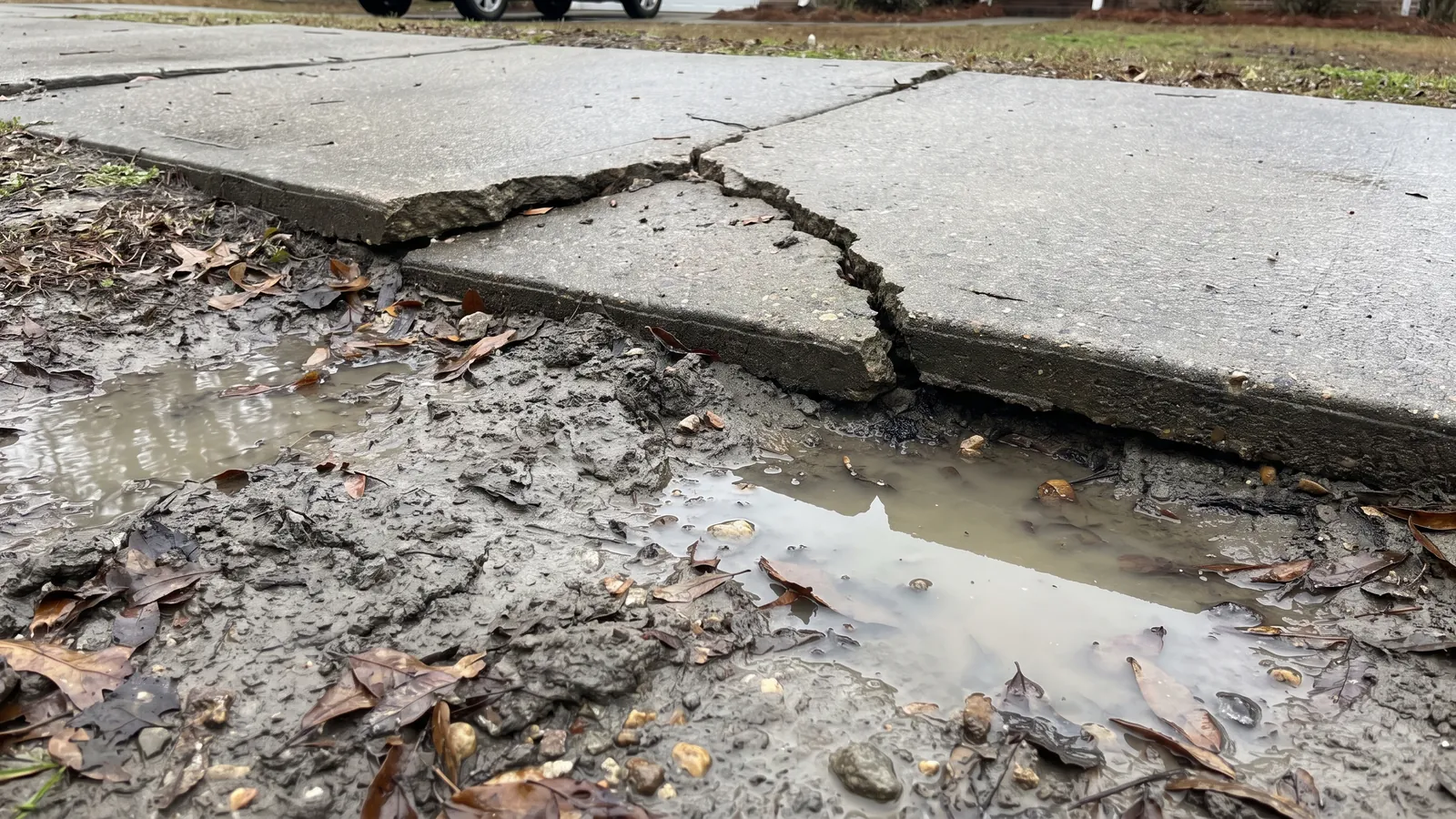
- Settlement. Wet soils consolidate under load. A slab on uncompacted scraped ground, or on the loose backfill against a garage foundation, sinks where the ground sinks — which is why nearly every 2000s driveway has dropped at the garage.
- Heave. The Mouzon, Brookman, Wahee, Coxville and Meggett clays swell wet and shrink dry. A walk or a patio on them lifts in a wet winter and drops in a dry August, and an unreinforced slab cracks at every cycle.
- Washout. Water moving under a slab — from a downspout, a broken irrigation line, a culvert that backs up, or Debby — carries the fines out of the base and leaves a void. The slab bridges it until a car parks on it.
- Frost. Summerville averages 45 nights at or below freezing — twice Charleston airport's 22 — and the January 2025 snow left ice on slabs for days. Wet ground under a thin slab freezes and lifts it; de-icing salt spalls the surface.
- Heat. Seventy-two days a year at or above 90 degrees. Concrete poured at noon in July flash-sets, dries before it cures, and shrinks — the random map cracking you see on summer pours. It's why we pour at first light, cut joints the same day and apply a curing compound.
- Rain. Fifty-two inches a year, 6.8 in July alone, 19 inches in a week in October 2015, 18 inches from Debby in 2024. A slab that doesn't drain is a slab that's underwater several times a year.
The builder's slab
Fifty-two percent of Summerville's homes were built after 2000 and a third in 2000–09, and the driveway on nearly all of them was poured the same way: lot scraped to grade, no stone base, no fabric, no reinforcement, three to three and a half inches of the lowest-cost mix, the apron poured in the same pass, control joints tooled shallow or not at all. On the sand ridge it might have lasted; on the Rains and Mouzon soils it didn't. The symptoms are predictable: a drop of an inch or two at the garage where the backfill settled, a longitudinal crack down the middle where the wire wasn't, a heaved panel at the walk, a puddle at the street where the apron was never graded, and spalling where the salt went down in 2018 and 2025.
What a slab that lasts here looks like
Soft spots dug out and the subgrade compacted. Geotextile fabric where the soil is wet, so the stone doesn't disappear into the mud. Four to six inches of compacted stone, deeper on the Rains and Coxville soils. Four inches of concrete minimum, six at the parking area, air-entrained for the freezes. Welded wire or #3 rebar on chairs, through all of it, for the clay. Control joints cut the same day at eight to ten feet, an expansion joint at the garage and the street, a grade of a quarter inch per foot that moves water off the slab and away from the house. A curing compound in summer. And on the swale roads, a culvert sized for the ditch and set at the invert so the next Debby goes under the apron instead of through it. It costs a dollar or two a foot more than the builder's version, and it's the difference between a driveway that lasts six years and one that lasts forty.
When it's already cracked
If the slab is sound — no cracks through the panel, reinforcement intact — and simply sunk, polyurethane foam lifting raises it back in a morning at a third of the cost of replacement, and it doesn't wash out the way mudjacking slurry does. If it's cracked into pieces, heaved on clay with no steel, or three inches thick with the aggregate showing, lifting won't hold; it's a replacement, built the way the paragraph above describes. We tell you which on site, with the reasons.
Common questions
Is my street on sand or clay?
The county soil survey maps it; roughly, the historic district and the old ridge streets are sand, the Ashley River side and the Dorchester Road neighborhoods are the wet Rains-Lynchburg soils, and the west and Ridgeville side have more Mouzon-Jedburg clay. We probe the actual ground on the estimate.
Can a new slab be poured over the old one?
Not a driveway — the old slab is the problem, and the new one would follow it. A sound patio or pool deck can take a bonded overlay for a new finish.
Why did my patio crack the first summer?
Poured in the heat without curing, joints cut late or shallow, and no steel. Shrinkage cracks appear within days. A joint plan and a curing compound are what prevent it.
Does the water table affect a patio as much as a driveway?
Yes — a patio on the Rains soils sits in water half the winter. The base over fabric and the drainage grade matter as much as they do under a driveway.
Related: Repair & leveling · Builder driveway replacement · Concrete driveways · Flood zones guide